
Out of Balance
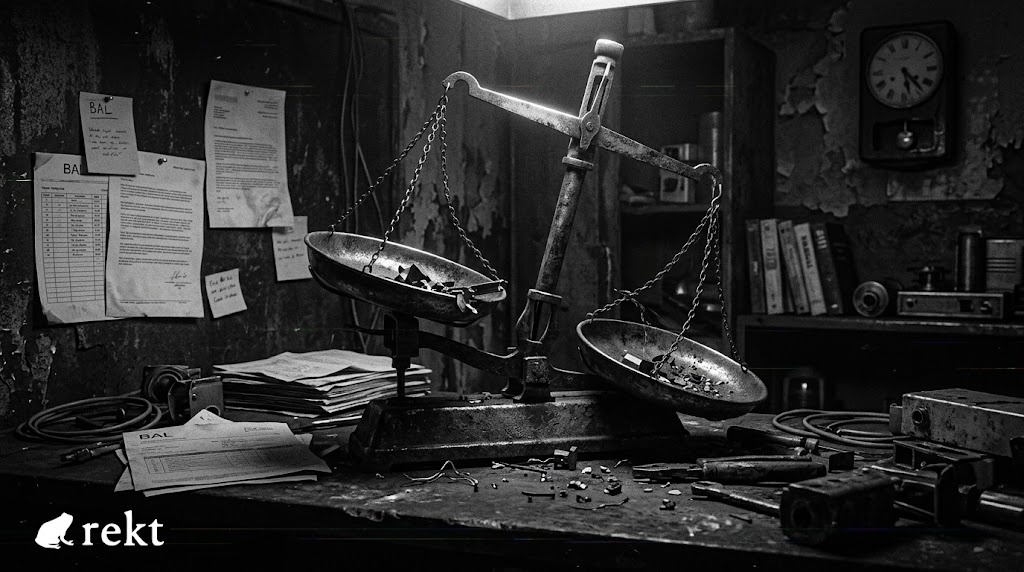
The last thing Balancer will ever weigh is itself.
On September 29, 42 votes representing 17.2 million BAL in voting power put one of DeFi's original AMMs on a shutdown clock.
The wind-down won 99.2% support, while a rival plan to revive the protocol under a new name failed the same afternoon.
Eleven months earlier, a rounding error buried in a scaling function drained $128 million from v2 pools, and Balancer's attempted turnaround never escaped the aftermath.
Balancer Labs shut down in March, and the leaner operation that followed spent roughly $150,000 a month against August protocol revenue near $30,000.
Pools begin moving to withdrawals-only on October 30, though some v3 pools can stay live until November 30 at partners’ request. Bug bounty coverage ends October 30 regardless.
BAL holders must wait until May 2027 to start burning their tokens for a share of the remaining treasury.
Beneath that orderly timetable sits a messier record: A post-mortem that leaves its own loss figures unreconciled , a reimbursement proposal conditioning claims on releasing Balancer from liability, and a voting-strategy error that prevented delegating holders from overriding their delegates, prompting a fix and restart of the fork vote.
The vote settled how Balancer would close, but not the accounting of how it got here.
If Balancer gets to write its own obituary, who checks the cause of death?

November 3rd, 2025 never really ended for Balancer.
It just moved from the war room to the legal department.
Two weeks after the drain, Balancer published its official post-mortem. The published text leaves its own loss and recovery figures unreconciled.
The introduction put the theft at an estimated $94.8 million. The Financial Impact section listed $121.1 million in losses, without explaining the roughly $26 million difference.
Balancer counted roughly $45.7 million as protected or recovered, though $19.3 million of that was liquidity that never left paused pools.
The reimbursement proposal covered roughly $8 million: About $3.86 million recovered by external whitehats and $4.11 million rescued internally from pools not yet exploited by outside attackers.
Applicable whitehat bounties would be deducted before the remaining tokens were distributed to eligible LPs in kind, through a 180-day claim window.
StakeWise's separately administered osETH and osGNO recoveries were valued at roughly $19.7 million in the reimbursement proposal.
The refund came with a signature line.
The reimbursement proposal required claimants to provide digital consent to terms releasing Balancer Labs, the DAO, the Foundation and affiliated parties from exploit-related liability. Whitehats seeking bounties, by contrast, had to complete identity verification, KYC and sanctions screening.
Claim your rescued funds, accept the release.
Four months later, on March 23, co-founder Fernando Martinelli announced that Balancer Labs would dissolve, citing "real and ongoing legal exposure" from the exploit.
The proposed release was a condition of claiming rescued funds. Legal exposure remained a reason to close.
The protocol stayed online, and in April holders approved a leaner operating structure, with a new OpCo and a plan to prove the battered AMM could pay its own bills.
Cutting costs was one task. Giving anyone a reason to come back was another.
How long does a fresh start last when the treasury is paying for it?
Leaner, Not Richer
April's rescue plan had every box ticked: Cut costs, end emissions, simplify the token, route the revenue home, and let v3 carry the growth.
Holders backed all of it. BIP-918 consolidated operations under Balancer OpCo and cut the team to 12.5 full-time equivalents, from roughly 25.
BIP-919 switched off BAL emissions, wound down veBAL and sent 100% of protocol fees to the DAO, up from 17.5%. It also proposed a BAL buyback at NAV, capped at 35% of treasury holdings and exercisable twelve months after the vote.
BIP-919 estimated NAV at about $0.16 per token. Balancer Labs CEO, Marcus Hardt later described the April buyback as priced at $0.1487 per token.
The same package reduced the v3 protocol share of swap fees from 50% to 25%, and explicitly warned that liquidity supported by incentives might leave once those incentives stopped.
By the end of September, DefiLlama-based reporting put TVL at about $58.5 million, down from $157 million in March.
The reset had not reversed the contraction.
New products arrived. AutoRange Pools shipped, and integrations were pitched across the ecosystem. Hardt said v3 was operating as designed.
“The product worked. It did not sell enough,” Marcus Hardt posted on Twitter.
The revenue figures showed the gap. Monthly protocol revenue reached $1.13 million in October 2025, the last full month before the exploit.
By June 2026, it had fallen to about $97,000.
For August, Hardt reported roughly $30,000 in protocol revenue. DefiLlama’s figure for the same month was $56,781.
Most revenue still came from legacy v2 pools.
Against that, the operation burned about $150,000 a month. Treasury yield under kpk’s management added roughly $25,000 back.
Hardt acknowledged that key people left or stepped back over the period, leaving the plan to run with less than it was designed for.
MAXYZ offered a harsher account. In a September 15 forum post, the group said the development team fell apart almost immediately and lacked a real roadmap.
Hardt said contributors received two months’ notice on August 27. The wind-down proposal would not appear publicly for another eighteen days.
Holders would vote on the protocol’s future after contributors had already been told to prepare for their own departures. MAXYZ proposed another path.
With the team already on notice, who was willing to bet on keeping the lights on?
Reincarnation Denied
MAXYZ moved quickly.
The day after Hardt posted the wind-down proposal, longtime contributors Gosuto and Zekraken signaled a fork on the forum.
They called the urgency unjustified and argued that Balancer should follow BIP-918's original Q2 2027 wind-down timeline.
On September 20, BIP-929 arrived with a title that left little room for interpretation: Fork and Reincarnate.
The pitch was a renamed successor built around Balancer's multi-asset pools and aimed at tokenized stocks.
MAXYZ’s illustrative calculation assumed that 10% of the top 10 stock exchanges’ daily trading volume would move onchain, that a one-basis-point fee would apply to that volume, and that the successor would capture 1% of the resulting fees.
On those assumptions, MAXYZ projected about $27.4 million in annual revenue, roughly 75 times Balancer’s revenue at the time.
The ask was concrete. MAXYZ wanted the remaining non-circulating BAL as a pre-seed grant: about 3.5 million from the treasury, 1.6 million from the Balancer Labs fundraise safe and 928k from the Labs team safe, roughly 6 million BAL worth about $690k.
It also wanted pools and vaults kept unpaused until the end of Q2 2027, except in an emergency, plus a perpetual, irrevocable, nonexclusive license to Balancer entities' intellectual property, which would become an exclusive assignment if those entities dissolved.
In return, Balancer's treasury would receive 10% of the fork's token supply, if a token ever launched.
The proposal carried its own conflict. MAXYZ held two of the seven Treasury Council seats, on the multisig that would send the grant. It offered to give both up before any BAL moved, dropping the signing threshold from 5-of-7 to 4-of-5.
One forum critic estimated the grant would dilute other holders by about 8.7%. MAXYZ agreed with the math, putting the cost at a little over a cent of NAV per BAL.
Support came from partners and insiders alike. Rocket Pool’s Val supported delaying the pause and said Rocket Pool might want to move some liquidity to a fork.
Royco and Tetu explicitly backed the fork, as did Balancer OpCo’s Danko.
Former Foundation board director Xeonus also supported it, disclosing that he was a founding member of MAXYZ and had been one of its operations signers since July
The revised wind-down included a concession: Partners could request that specific v3 pools remain live until November 30.
Then, mid-vote, the ballot box broke.
On September 26, Fernando Martinelli relayed signed messages from two holders who said they held more than 400,000 and 480,000 BAL, but saw zero voting power.
Hardt traced the problem to the 1-BAL-1-vote strategies in use since July 7. Unlike the strategies listed in BIP-921, they did not preserve a delegating holder’s ability to override their delegate. Delegating holders, he wrote, had not been told.
MAXYZ said it fixed the strategy and reset the fork vote.
The restart didn't save the fork. BIP-929 failed with 69.9% against, across 17.33 million BAL in voting power.
With the fork rejected and the exit schedule set, what was a BAL worth on the way out?
Sixteen Cents, Maybe
There was a market price, an estimated treasury value per token, and a redemption value nobody could fix yet.
The first was the market. BAL traded around $0.13 on October 1, two days after the vote.
The second was Hardt's. In a September 20 update, he put the distributable base at $9,959,416 in non-BAL assets against 63,068,821 redeemable BAL.
His calculation used September 18 onchain balances and DefiLlama prices, producing an estimated $0.1579 per token. He described it as his own measurement, not an audited one.
The denominator changed in that update. The original draft borrowed BIP-919’s circulating-supply definition; Hardt’s revision excluded all BAL held by the DAO and its entities, along with the BAL permanently locked behind tetuBAL, about 9.3 million tokens in total.
The redeemable-supply figure included the treasury BAL that would be paid to tetuBAL holders, whose permanent lock means their BAL cannot otherwise become redeemable. Voters later chose the 50% option.
The third answer did not exist yet. The final base would be measured and audited at the opening snapshot in late May 2027, then paid in kind, in the assets the treasury held at that point.
That last part matters. Head of operations Danko argued for converting to stablecoins so holders could know their number now.
Hardt kept the distribution in kind. Fernando Martinelli backed him, pointing to a possible bull market and the cost of dumping partner tokens.
That basket is concentrated. Sentralis, a crypto risk analytics team, counted staked AAVE at 27% of the base at September 21 prices, and disclosed that nobody at Balancer asked or paid for the work.
Modelling where the per-BAL value could land by the end of May 2027, one model calibrated on the past year's volatility put 90% of outcomes between $0.115 and $0.285.
A second, replaying the past twelve months as they happened, put its comparable range between $0.103 and $0.206.
Then there’s the clock. Holders get six months, from the end of May to the end of November 2027, to burn their BAL; unclaimed shares later flow, through automatic distributions, to those who did.
Hardt answered that fourteen months separate the proposal from the close of round one, and confirmed that unredeemed shares go pro rata to redeemers, himself and BAL-holding contributors included.
tetuBAL holders, whose BAL can never leave its lock, will receive treasury BAL equal to half the amount behind their tokens.
Voters chose 50% over 100% by 12.2 million to 4.91 million BAL.
Whatever explained the gap between BAL's roughly $0.13 market price and Hardt's $0.1579 treasury-value estimate, the first-round redemption value would not be fixed until the May 2027 snapshot.
Within the same week holders were debating whether to convert the treasury to stablecoins, the Treasury Council had been running a separate sell order on COW, a partner token.
What was it selling, and why?
Open Tabs
The answer surfaced in a different thread: BIP-931, CoW DAO’s September 21 proposal to unwind its January 2025 token swap with Balancer.
On September 22, Danko disclosed that the Treasury Council, as agreed with treasury manager kpk, had placed a TWAP order the previous week to sell COW held outside the BIP-770 token swap.
CoW DAO's representative described it as 30 parts covering 509,000 COW at a limit price of 0.119737.
The Council revoked it the same day that Danko posted.
The revocation followed CoW DAO’s offer to unwind the January 2025 swap: Balancer would get back its 200,000 BAL plus about 29.95 ETH for its remaining COW, priced on a 15-day TWAP after Fernando Martinelli objected that a 30-day window captured COW’s run-up. BIP-931 went to Snapshot on October 2.
BIP-928 says wind-down-related fund movements wait for the vote, while kpk proposes consolidation under its existing mandate.
As of publication, the forum did not explain whether the COW sale fell under BIP-928’s wait-for-vote rule or kpk’s consolidation mandate.
Other tabs remain open.
Bug bounty coverage ends October 30 for every pool, including v3 pools partners asked to keep live until November 30. Hardt's advice to LPs in those pools: exit by October 30 if you want out while still covered.
As of October 14, we could not find the list of extended pools, the pool-by-pool treatment or the withdrawal guides, each promised before October 30.
Redemption itself is still more than seven months away. Balancer has already warned that any site or DM offering to redeem BAL before then is a scam.
When the Treasury Council's signing role ends after the final sweep in 2028, who will still be around to close these tabs?

Balancer is doing the visible work of an orderly exit.
It gave notice. It published a timeline. It put the treasury on a schedule, said withdrawals would remain open and told holders exactly when not to trust a redemption link.
But an orderly exit only settles the order. The post-mortem still carries unreconciled loss figures and a placeholder.
The reimbursement proposal conditioned claims on a liability release.
A voting strategy ran for nearly three months, from July 7 until its September 26 reset, without the delegate override BIP-921 had preserved.
As of publication, nobody had said which mandate covered a COW sell order placed before the vote.
None of it changes the vote. All of it belongs in the record the vote leaves behind.
The wind-down is scheduled to reach its final sweep in July 2028. The record will outlast the institutions responsible for answering its questions.
Once the last signer walks away, who answers for what never balanced?

REKT представляет собой общественную площадку для анонимных авторов. Мы не несём ответственность за выражаемые точки зрения или контент на этом веб-сайте.
Пожертвование (ETH / ERC20): 0x3C5c2F4bCeC51a36494682f91Dbc6cA7c63B514C
Дисклеймер:
REKT не несет никакой ответственности за любое содержание, размещенное на нашем Веб-сайте или имеющее какое-либо отношение к оказываемым нами Услугам, независимо от того, было ли оно опубликовано или создано Анонимным Автором нашего Веб-сайта или REKT. Не смотря на то, что мы устанавливаем правила поведения и нормы публикаций для Анонимных Авторов, мы не контролируем и не несем ответственность за содержание публикаций Анонимных Авторов, а также за то, чем делятся и что передают Авторы с помощью нашего Сайта и наших Сервисов, и не несем ответственность за любое оскорбительное, неуместное, непристойное, незаконное или спорное содержание, с которым вы можете столкнуться на нашем Веб-сайте и на наших Сервисах. REKT не несет ответственность за поведение, будь то онлайн или офлайн, любого пользователя нашего Веб-сайта или наших Сервисов.