
The Big Blind
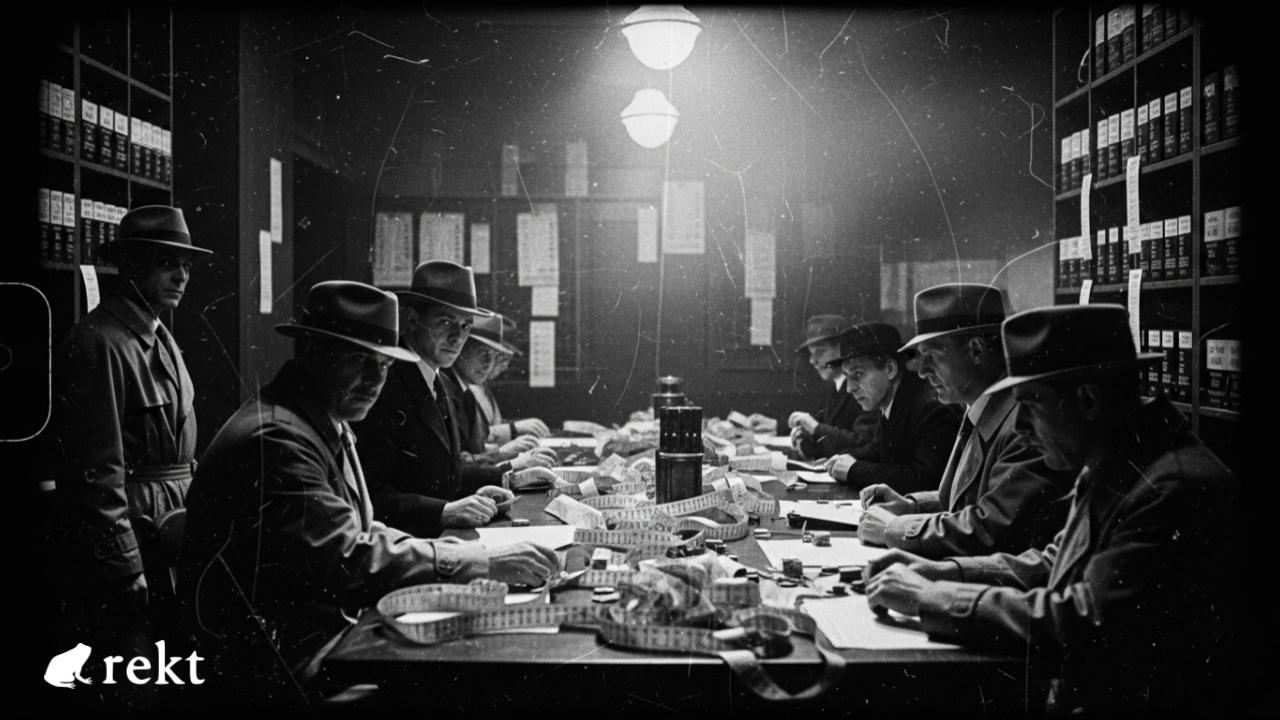
Welcome to the new Vegas, where research papers replaced car bombs and dashboards replaced count rooms.
Paradigm led a $1 billion investment into Kalshi on December 2, 2025.
The investment came from Sequoia, Andreessen Horowitz, Meritech Capital, IVP, ARK Invest, Anthos Capital, CapitalG, and Y Combinator. The Series E valued Kalshi at $11 billion - double what they were worth sixty days earlier.
Six days later, Paradigm’s data researcher, Storm Slivkoff published findings that cut Kalshi’s competitor Polymarket's trading volume in half.
Polymarket's data team fired back immediately: they knew about this "bug" and told Paradigm about it two months ago in a private chat.
Exposing inflated numbers took decades when investigators needed wiretaps and informants.
One researcher with a transaction simulator and six days between a venture round and a technical blog post just proved transparency moves faster than it used to.
Count rooms became dashboards, cash bags became cap tables, and regulatory investigations became research papers - but when the timing benefits the researcher's portfolio company, who's really getting transparent with whom?

Prediction markets backed by Wall Street money and NYSE partnerships sounded legitimate until the numbers stopped adding up.
Shayne Coplan founded Polymarket on the Gnosis Conditional Token Framework. Founders Fund - Peter Thiel's outfit - backed the early rounds. Then came ICE, the parent company of the New York Stock Exchange.
ICE invested $2 billion into Polymarket on October 7, 2025, valuing the platform at $9 billion post-money.
A month later, on November 13th, Coplan rang the opening bell at the NYSE.
Partnerships followed: UFC and Zuffa Boxing signed on as official prediction market partners. ICE became the global distributor of Polymarket's data feeds, positioning the platform as infrastructure rather than gambling site.
The pitch centered on one promise: Prediction markets - decentralized, transparent, neutral platforms where users bet against each other while the protocol facilitates without taking positions.
The key metric backing everything? "$25 billion in lifetime volume."
(Editor's Note: The source link above reflects the pre-correction data widely cited at the time, which notably hasn't been fixed yet.)
Across town (digitally speaking), Kalshi positioned itself differently.
Kalshi received their Designated Contract Market (DCM) designation on November 3, 2020, but they did not launch the platform to the public until July 2021. Therefore, every single day they have been open for business, they have been regulated.
Backed by Sequoia Capital, Andreessen Horowitz, Capital G, and ARK Invest - the kind of institutional money that demands regulatory compliance before cutting checks.
Kalshi raised $300 million at a $5 billion valuation in October 2025.
Then Paradigm led their $1 billion Series E at $11 billion on December 2nd - doubling the valuation in less than sixty days.
The same day, CNN and Kalshi announced their partnership. Kalshi's real-time probabilities would display during live broadcasts with ticker integration.
Matt Huang, Paradigm's co-founder, framed the investment: "We see this as an uncapped cultural and economic phenomenon, similar to how we felt about crypto a decade ago."
Nine days later, on December 11th, Kalshi joined the Prediction Market Coalition with Crypto.com and other platforms - creating a unified lobbying front.
Translation: The industry is organizing for regulatory capture before the real fight even starts.
Two platforms. Two strategies. Both claiming neutrality while building something else entirely.
Polymarket went offshore after a $1.4 million 2022 CFTC fine, rebuilt in crypto–native territory without KYC requirements, then acquired a CFTC-licensed exchange (QCX) for $112 million in July 2025 to engineer their US re-entry.
Kalshi played a different game. Years of regulatory courtship. CFTC approval. The safe bet for institutions that wanted prediction markets without the offshore stink.
November 2025 volumes looked competitive on paper. Polymarket showed $3.74 billion monthly spot volume and Kalshi showed $5.8 billion during November as well.
Exponential growth everywhere you looked.
Both platforms claimed exponential growth. Both promised transparent, neutral marketplaces.
But while Polymarket was preparing to launch an internal market-making desk, Kalshi was already operating one.
Their affiliate, Kalshi Trading LLC, actively trades on the platform - a practice that sparked a class-action lawsuit alleging the "neutral" exchange was actually betting against its own customers.
When two competitors pitch institutional legitimacy while both plan to become the house, who's actually running a neutral exchange?
The Reverse Skim
Vegas count rooms operated on simple math - take cash off the top before anyone officially saw it.
In the case of Polymarket, it was revealed that the Third-party dashboards worked in reverse - they inflated the numbers that investors saw.
Every trade on Polymarket generates two OrderFilled events through their smart contracts.
One event tracks the Maker (the liquidity provider with an existing order). Another tracks the Taker (the user executing against that order).
These events describe the same trade from different perspectives - not two separate transactions.
Third-party dashboards (Dune Analytics, DefiLlama, Blockworks) were summing both events.
Every $100 trade got counted as $200 in volume.
The following transaction shows this clearly: 0xbf47fbf1bc113a7ec50a1103921265ba5d8fbe6dfb4d12a1c78c61c8fdb195bf
Actual trade: $4.13 exchanged for YES tokens
OrderFilled events emitted: Two events of $4.13 each (maker-side and taker-side)
Dashboard reporting: $8.26 in cashflow volume (double-counted)
The bug inflated both notional volume (number of contracts traded) and cashflow volume (USD value at time of trade).
Every trade. Every market. Every day.
November 2025 was reported at $3.7 billion. Actual volume may have been closer to $1.9 billion if Paradigm's research is correct. Even DefiLlama has adjusted the volume to reflect the smaller number.
Lifetime numbers told the same story. Dashboards showed roughly $25 billion. Reality looked more like $13.5 billion.
Polymarket's own site always displayed the correct numbers - taker-only volume, the same methodology Kalshi uses. Their internal metrics were accurate.
Dan Smith from Blockworks caught it back in August 2024. He wondered why dashboards were summing OrderFilled events without separating maker and taker sides.
Specific transactions. Clear examples. Math that didn't add up.
Crypto data analyst circles discussed it privately. Polymarket's data team responded in those chats, confirmed the methodology issues, then everyone moved on.
According to Polymarket's Primo Data, Paradigm was in those same chats - aware of the issue months before their research paper.
Public dashboards kept showing doubled volume for months. Media reports cited "$25 billion in trading volume" when covering fundraising and investments. Nobody motivated to correct the public record did anything about it.
Storm Slivkoff built a transaction simulator that modeled all eight of Polymarket's trade types. He audited the smart contract event emission code. He examined data invariants across both their CTF Exchange and NegRisk contracts.
His conclusion: The confusion resulted from "interacting layers of complexity" where eight distinct trade types produced redundant event streams, creating a data knot that standard block explorers were "not sufficient" to untangle.
The research was thorough. The methodology was sound. The timing was interesting. It should also be worth noting that storm hammered through the point: “this investigation was just about 3rd party dashboards.”
Vegas operators needed over a decade to get caught because the evidence disappeared into suitcases headed to Kansas City.
Polymarket's evidence lived permanently on-chain, timestamped and immutable - but nobody looked closely until someone with a $1 billion reason to look decided it was time to publish.
When your competitor's key metric gets cut in half six days after you bet against them, was the research motivated by truth or tactics?
The Diligence Trap
Bugsy Siegel caught bullets when the Flamingo bled money.
Polymarket caught a research paper when their numbers got too good.
The Paradigm led investment on December 2nd doubled Kalshi to $11 billion. Matt Huang didn't hedge: "We see this as an uncapped cultural and economic phenomenon, similar to how we felt about crypto a decade ago.
Translation: We're not making a bet. We're picking the winner.
The same day, Kalshi announced their CNN partnership. Real-time probabilities during live broadcasts. Ticker integration. Mainstream legitimacy wrapped in cable news credibility.
Ironically right around that time, Polymarket was reportedly in late-stage fundraising talks.
Bloomberg had reported back in October they were seeking $12 to $15 billion in early-stage fundraising talks.
Reports were citing '$25 billion in trading volume' when covering the platform's meteoric rise.
Then on December 8, 2025 - Storm Slivkoff dropped his thread on Twitter:
"Found a pretty major data bug. it turns out almost every major dashboard has been double-counting Polymarket volume (not related to wash trading). this is because Polymarket's onchain data contains redundant representations of each trade."
He linked to the full research at paradigm.xyz. Transaction simulator. Contract audits. Data invariant analysis. Six months of work published on a Sunday morning.
Matt Huang amplified it a few minutes later: "Polymarket data bug: volumes are double-counted in most public data. Interesting find in diligence from notnotstorm"
"Interesting find in diligence."
Not "we discovered a systemic issue affecting market transparency." Not "our researcher identified measurement problems."
Diligence. The word investors use when they're evaluating a target before writing a check or placing a competitive bet.
November volume crashed from $3.7 billion to $1.9 billion in public perception. Lifetime volume got cut from $25 billion to $13.5 billion.
Right as Polymarket was pitching double-digit billion dollar valuations to investors who use volume as their primary metric.
Primo Data, Polymarket's data guy, responded within hours:
"This is not how prediction markets report volume, including your portfolio company Kalshi. To be clear: Our site does not double count volume. We show notional taker volume (same as Kalshi). Dan Smith (Blockworks) asked this question back in October in a crypto data group chat we're both in, and you saw my response over 2 months ago."
Read that last line again.
If Primo's claim holds up, Paradigm knew about the volume methodology issue since October. They watched third-party dashboards display inflated numbers for two months. Then published the research six days after investing $1 billion in Polymarket's direct competitor, timed perfectly to detonate during Polymarket's fundraising window.
DefiLlama, Allium Labs, and Blockworks, confirmed they are updating their Polymarket dashboards to eliminate double-counting after validating Slivkoff’s findings.
Will Sheehan from Parsec Finance called it: "Reads a bit like a hit piece when it's just data being hard and Polymarket's contracts being open/onchain."
Nick Preszler from Melee Markets pointed out: "If a user buys $10 worth of contracts at .1c each, they are risking $10, but get credited for $10,000 of volume because they have purchased 10,000 contracts. ."
Hildobby from Dragonfly claimed: "Every half decent dashboard has had this accounted for since at the very least 2024. See dune tables with matched orders attached for example.”
Six days between investment and exposure. Decades of mob operations got taken down by FBI wiretaps, informants who flipped, and patient federal prosecutors.
One researcher with blockchain data and strategic timing just moved faster.
When the guy who just bet $1 billion on your competitor publishes research that cuts your valuation metric in half during your fundraising window, is that transparency or tactics?
Becoming the House
Every mob casino had a front man - someone with a clean record who signed the license paperwork while the real operators ran odds from the back room.
Both platforms claimed neutrality. Both positioned as exchanges connecting buyers and sellers.
Neither mentioned they were hiring the guys who'd take the other side of your bet.
On December 4, 2025, Bloomberg dropped a different bomb: "Polymarket is recruiting staff for an internal market making team that would trade against customers on its exchange."
Not "provide liquidity." Not "facilitate markets." Trade against customers.
The plan looked straightforward. Hire professional traders. Give them access to platform data - order flow, deposit patterns, user behavior. Have them take positions opposite retail users. Call it liquidity provision.
Harry Crane, statistics professor at Rutgers, cut through the spin: “Does it blur the line between a prediction market and a traditional sportsbook? Yes, but it's worse than that,” he said. “At a sportsbook it is well understood that the book is the counterparty, and will use whatever information it can to get the edge over its customers. Exchanges are supposed to be different.”
Translation: You joined because it wasn't a sportsbook. Now they're building a sportsbook.
Polymarket was late to this particular party.
Kalshi already operates "Kalshi Trading" - their internal market-making desk. November 2025 brought a class-action lawsuit alleging the desk "sets betting lines that disadvantage customers."
Users thought they were betting against other users. Turns out they were competing against a sophisticated market maker with platform-level data access and no requirement to disclose its positions.
Both platforms spent years pitching themselves as neutral infrastructure. Decentralized truth markets. Platforms that don't take sides.
Both quietly built operations that profit when users lose.
Then there is the NoVig Lesson highlighted by Harry Crane.
NoVig proved what happens when platforms become counterparties.
Another prediction market platform. Internal market-making desk. Everything was running smoothly until their desk ended up on the losing side of trades.
Response? Void the winning bets.
When the house loses, the house changes rules.
Same story told in different venues across decades.
Allen Glick owned four Vegas casinos through Argent Corporation. Clean record. Legitimate businessman. Perfect front.
Behind him? Frank "Lefty" Rosenthal ran operations. Tony "The Ant" Spilotro handled enforcement. The mob called every shot.
When the FBI finally connected the dots, Glick cut a deal and walked. The actual operators went to prison.
Polymarket and Kalshi both claim to be neutral exchanges just connecting users.
Both are recruiting traders to bet against those same users. Both have access to data retail never sees.
The front man signs the papers. The real operators run the odds.
When your "neutral exchange" starts hiring the bookies, who's holding whose license?
Buying Legitimacy
Senator Pat McCarran killed every attempt at federal gambling oversight for one simple reason - it would have devastated Nevada’s entire economy.
Regulation became theater. Gaming Control Board created a Black Book listing banned mobsters. Meanwhile, those same mobsters kept running count rooms while their front men smiled for cameras.
Then there’s Kalshi's Play.
Years of CFTC courtship paid off in 2020 with approval to offer event contracts.
Positioning as "the regulated one" became their competitive weapon. Every pitch meeting started the same way: we have federal approval, they fled offshore.
December 2, 2025 made it official with a CNN partnership. Real-time probabilities during broadcasts. Cable news credibility blessing prediction markets for mainstream consumption.
CNBC followed with similar integration. Kalshi's odds will be appearing next to stock tickers and economic data.
Your morning business news now includes betting lines on Fed rate decisions, next quarter's inflation, and who wins the Oscars.
The partnerships weren't just marketing - they moved the market.
In December 2024, Polymarket controlled 95% of prediction market volume. By December 2025, Kalshi commanded 78%. One year to flip everything.
But here's what those headline numbers hide: Kalshi's incoming CFO admitted on their Q3 earnings call that "a very large chunk of Kalshi's volume is actually coming from Robinhood."
Not sophisticated prediction market traders. Retail brokerage users who already had accounts. Robinhood processed 2.5 billion prediction market contracts in October alone.
Kalshi didn't need to convince anyone to join a new platform. They got shelf space in apps people already used. Webull added Kalshi integration in February. PrizePicks brought Kalshi contracts to 38 states in November.
The wallet wars followed the same logic. MetaMask integrated Polymarket into its mobile app in December. Trust Wallet launched a Predictions hub preparing to add both platforms - 220 million users up for grabs.
Distribution became destiny. Regulatory approval didn't just provide legitimacy - it unlocked partnerships with every retail investing app looking for a new product category.
Polymarket couldn't play that game. The 2022 CFTC ban locked them out of every US partnership Kalshi was building. So they bought their way back in.
In July 2025, they acquired QCX - a CFTC-licensed exchange - for $112 million. Regulatory compliance purchased rather than earned.
The CFTC issued a no-action letter in September 2025. Path cleared for US re-entry through closed beta.
Different strategy, same goal - regulatory capture through acquisition instead of courtship.
Polymarket got the Corporate Blessing.
ICE's $2 billion investment into Polymarket wasn't just capital. It was a legitimacy transfer.
Jeffrey Sprecher, ICE CEO: "Our investment blends ICE, the owner of the New York Stock Exchange, which was founded in 1792, with a forward-thinking, revolutionary company pioneering change within the Decentralized Finance space."
Translation: we're making gambling look like investing.
NYSE parent company betting billions on prediction markets signals institutional acceptance.
Wall Street's imprimatur replacing regulatory suspicion.
CNN and CNBC partnerships do the same work. Media companies aren't just covering prediction markets - they're integrating them into financial news broadcasts. Odds appearing next to S&P 500 tickers normalize betting as price discovery rather than gambling.
Same playbook from different decades.
Nick Civella, Kansas City mob boss, understood it perfectly: You need cash money to obtain and maintain political connections. That cash would come out of Las Vegas casinos.
VCs use institutional capital, media partnerships, and exchange alliances the same way.
First-mover advantage in regulatory approval creates a moat. Compliance becomes competitive advantage. The "legitimate" operation gets CNN deals while offshore competitors scramble to buy their way back in.
Matt Huang called it an "uncapped cultural and economic phenomenon." Not gambling platforms seeking approval - inevitable infrastructure that Wall Street needs to own.
Both platforms are racing to become regulated. Both spending hundreds of millions to secure blessing from agencies or acquire companies that already have it. Both partnering with traditional finance and media giants to normalize betting markets.
Regulation was supposed to protect users. Instead it became another moat to buy, another competitive advantage to purchase, another way to separate the platforms with resources from those without.
When compliance costs $112 million and legitimacy requires partnering with the NYSE, who's really getting regulated - the platforms or the users trying to access them?
The Corporate Takeover
Howard Hughes went on a buying spree in the late 1960s, acquiring several casinos across Nevada for an estimated $300 million.
Nevada officials sold Hughes as salvation: cleaning up Vegas, making it respectable. His presence triggered the 1967 Corporate Gaming Act, opening the door for Wall Street corporations to enter an industry controlled by organized crime.
The reality looked different. Hughes lost money on most properties. Operations barely changed - same dealers, same pit bosses, same games running the same way. But it looked legitimate on paper.
Wall Street liked the story. Investors felt comfortable.
By the 1980s, the transformation was complete. Hilton owned multiple properties. MGM built empires. Corporate conglomerates ran the Strip.
Vegas became family entertainment - Disney World with slot machines and shows.
Nobody talks about the mob anymore. Not because they disappeared, but because they sold out at the right time to the right buyers.
Maybe Paradigm and Founders Fund aren't fighting to run prediction markets.
Maybe they're fighting to package one for sale.
ICE's $2 billion bet on Polymarket wasn't about becoming a crypto company. Jeffrey Sprecher made that clear - blending 1792 NYSE pedigree with DeFi innovation.
Translation? We're making this palatable for institutional allocators.
Was Shayne Coplan ringing the opening bell at NYSE not just a ceremony, but also product placement?
Polymarket getting photographed in the temple of traditional finance, it is a blessing from the institutions that matter.
ICE becomes the global distributor of Polymarket's data feeds. Partnerships on tokenization initiatives. Integration into the financial infrastructure that moves trillions.
Kalshi took a different route but toward the same destination.
CNN and CNBC deals put their odds directly into mainstream financial news. Real-time probabilities appearing next to bond yields and currency rates.
Maybe Matt Huang's "uncapped cultural and economic phenomenon" language wasn't hype. Maybe it was positioning for the pitch meeting that happens in 2028 or 2030 when Paradigm needs to exit.
The buyers won't be retail degens or crypto funds. They'll be sovereign wealth managers, pension allocators, the same institutions that need regulatory approval and mainstream legitimacy before they touch anything.
What gets sold won't be gambling platforms or prediction markets.
It'll be infrastructure for pricing uncertainty.
The winner gets packaged as CFTC-approved financial technology with partnerships through traditional exchanges like NYSE and CME. Integration with mainstream media through CNN and CNBC. Institutional-grade market making and liquidity. Data feeds that plug into existing financial terminals.
The degens who used these platforms to bet on election outcomes and disaster probabilities were beta testers.
Whether volume showed $25 billion or $13.5 billion matters less than what institutional buyers pay in 2030.
Five years seems about right for the timeline. Clean up the industry. Kill or acquire the competitors. Get regulatory approval locked down. Build partnerships with institutions that confer legitimacy. Demonstrate consistent revenue through market making rather than just transaction fees.
Then sell to whoever writes the biggest check - probably someone already integrated into global finance who sees prediction markets as the next derivative product to offer wealth management clients.
Hughes lost money running casinos, but his estate made a fortune selling them to corporate giants like MGM.
The mob guys who actually knew how to operate count rooms went to prison.
The corporate buyers who knew how to operate quarterly earnings calls became billionaires.
Maybe Paradigm isn't spending six months building transaction simulators because they love data accuracy.
Maybe they're eliminating competitive threats to their portfolio company before the sale process begins.
When your "truth market" becomes another product in the wealth management catalog, whose truth gets priced - yours or theirs?
The Echo Chamber
How does a $11.5 billion discrepancy slip past the industry's most trusted data monitors?
It wasn't a conspiracy. It was a structural blind spot.
Blockchain analytics platforms rely on open-source code submissions to track volume. The review ensures code runs - not that it's measuring correctly.
Once deployed, consensus becomes truth. The second analyst checks the first dashboard. The third checks the second. Matching numbers harden into fact.
Dan Smith from Blockworks flagged the double-counting back in August.
Hype drowns out questions. When numbers look good, nobody checks if inputs are duplicated.
These dashboards aren't auditors. They're aggregators of self-reported logic.
If the watchdogs are grading the homework based on the honor system, are we looking at verified data, or just a decentralized marketing brochure?

The casinos didn't disappear when the Mob left Vegas; they just got better lighting and corporate HR departments.
The "skim" didn't vanish either - it just evolved from a bagman in a count room to a "methodology update" on a dashboard.
Today they call it a "data bug." We used to call it "the vig." And just like back then, the guys running the count room are the only ones getting rich.
Kalshi and Polymarket aren't fighting a war for the soul of prediction markets. They are fighting for the right to sell the concession stand.
The winner won't be the platform with the most accurate odds or the most transparent code. It will be the one that looks cleanest in a pitch deck.
In the end, we aren't the players, and we definitely aren't the house. We're just the liquidity that flows through the machine while the ownership class negotiates the sale price.
As Lefty Rosenthal might have said if he had a GitHub repo: "There are three ways to do things: the right way, the wrong way, and the way that gets you a $25 billion valuation."
And that’s that. The degens cleared the land, the VCs poured the concrete, and now Wall Street is just moving in the furniture.
When the house is owned by Wall Street and the odds are set by an algorithm, ask yourself: are you still the player, or are you just the liquidity?

REKT는 익명 작성자들에 의한 공공 플랫폼이며, REKT에 작성된 관점이나 내용에 대해서 그 어떤 책임도 지지 않습니다.
기부 (ETH / ERC20): 0x3C5c2F4bCeC51a36494682f91Dbc6cA7c63B514C
disclaimer:
REKT는 당사 웹 사이트의 익명의 작성자 또는 REKT에 의해 게시되거나 관련된 서비스에서 게시되는 콘텐츠에 대해 어떠한 책임도 지지 않습니다. 당사는 익명 작성자들의 행동 및 게시물에 대한 규칙을 제공하지만, 익명의 작성자가 웹 사이트 또는 서비스에 게시, 전송 혹은 공유한 내용을 통제하거나 책임지지 않으며, 귀하가 웹 사이트 또는 서비스에서 직면할 수 있는 불쾌함, 부적절함, 음란함, 불법 또는 기타 해로운 콘텐츠에 대해서도 책임을 지지 않습니다. REKT는 당사 웹 사이트 또는 서비스 사용자의 온라인 또는 오프라인 행위에 대한 책임을 지지 않습니다.